
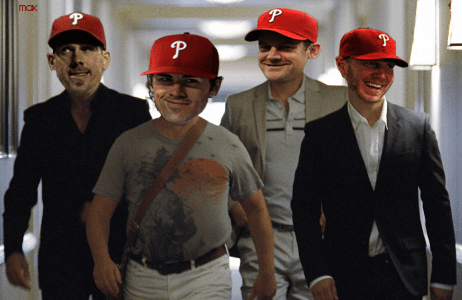
Now that the MLB free agent market is just about dried up, this is the time of year teams start kicking the tires on veterans well passed their prime. One name that resurfaced this week for the first time in months was Cliff Lee. Rumors began to swirl about teams keeping tabs on the injured former ace, but clubs seem to already be shying away thanks in large part to a steep asking price.
Whether Cliff Lee throws another pitch for an MLB team is yet to be decided, but one thing is for sure, he’ll never don red pinstripes again. With this sad fact comes an even sadder realization, this is the official death of R2C2 (AKA The Legion Of Arms, AKA the Four Aces, AKA the Phour Horseman, AKA a lot of different things).
Lee’s departure from the team signaled the end of an era, he was the last member of the Phillies’ greatest rotation to officially leave.
The first to go was Roy Oswalt, who left the team the very next season. Injuries kind of sapped the last Oswalt’s talent forcing him to leave the Phils’ rotation earlier than all the others. Next went Roy Halladay. When he came to the Phillies, fans knew that it would be short lived, but after four seasons with the club Halladay was forced to hang up the cleats, again due to injury. Cole was next to officially go, rather than being forced to wither any further on subpar Phillies teams, the organization was merciful and traded him to the Rangers this past trade deadline. Its kind of funny that the homegrown ace was the one who fixed the mess caused by going after the other three aces. Cliff Lee, for all intents and purposes, basically left the club last season. After pitching in nine games, Cliff was placed on the DL for the remainder of the season and his Phillies’ career.
Oh and how could we forget the staff’s unsung hero, Vance Worley! Who was traded in 2013 for the Philadelphia sports icon, Ben Revere.
Though the successes of this rotation were short lived and they’re marked with the failure of being unable to win the club its second World Series and officially bestow dynasty status onto the team, when things were good they were GOOOOOOOOOOOOOOOOOD. This was the rotation that led the Phillies to a franchise record 102 win season, they could have easily had more if they didn’t rest their starters for a good chunk of September.
As a whole this rotation had three Cy Young Awards, six 20 win seasons, 19 All Star appearances (3 of which came in 2011), a Comeback Player of the Year award, an NLCS and World Series MVP, a perfect game, and the second no hitter in playoff history. That’s a pretty decent resume.
In 2011, no one could compete with this rotation. As a whole, the Phillies’ rotation finished with an MLB-best 3.02 ERA, that was .18 lower than the second place staff and a full .40 lower than the third. This pitching staff threw 12 shutouts in the first 80 games of the season, which is tied for ninth all time in that span, and then threw another nine over the last 80 games of the season; those 21 shutouts lead the majors. This group was first in complete games (18), second in innings pitched (1477), first in quality starts (108), third in strike outs (1332) and third in batting average allowed (.240). That is what you call domination folks, something Phillies fans sadly don’t know much about anymore.
From an individual standpoint, Roy Halladay and Cliff Lee finished second and third in the MLB with ERAs of 2.35 and 2.40. Cole Hamels was eighth in the MLB with a 2.79. Roy Oswalt was last in rotation in ERA with a respectable 3.69, Vance Worley even finished with a better ERA at 3.01. In terms of strikeouts, Cliff was third in the bigs with 238, Halladay was tied for seventh with 220, Cole was 19th with 194, Oswalt was well behind the rest of his rotation with 93, again finishing behind Vance Worley who had 119. Halladay led the group in wins finishing tied for fourth in the bigs at 19. Cliff Lee finished the year tied for seventh with 17. Kid Cole was tied for 21st in the league with 14. And Oswalt rounded out the bunch with 9 wins, once again falling behind Vance Worley who had 11. Cliff Lee also led the team in complete game shutouts with 6, Halladay was the only other pitcher to throw a complete game shutout and he only did it once.
If it weren’t for Clayton Kershaw introducing himself to the rest of the baseball world, one of these Phillies probably would of went home with some gold. The Phillies had three pitcher finish in the top five of Cy Young voting, Halladay finished second, Cliff third, and Cole fifth. Halladay was the only one of the three to receive first place votes. The thing that surprised me the most was the fact that Roy Halladay finished ninth in MVP votes, that’s the most votes any pitcher received and three spots ahead of Kershaw. This was the year Justin Verlander won MVP so it wasn’t quite trendy yet to give the award to pitchers, so Halladay finishing highest among national league pitchers is really something. Meanwhile, Cliff Lee finished 15th in MVP voting.
Even Vance Worley got in on the award season fun finishing third in the NL Rookie of the Year vote.
This group is by far the best rotation the Phillies have eve known, but where they stack historically is up for debate. When you compare the 2011 Phillies rotation with the likes of the ’71 Orioles and the ’93 Braves, you start to get an idea of just how good this rotation really was. They may not have four 20 game winners like the Orioles or all the awards of the Braves, but when you compare these staffs as four man rotations, they stack up surprisingly well. Halladay, Lee, Hamels, and Oswalt finished as a group with an era of 2.80, that’s .08 better than the Orioles (2.88) and .23 better than the Braves (3.03).
The biggest thing that separates these three pitching staffs is innings pitched. Three of the Orioles top four arms almost threw 300 innings, averaging 270 innings per pitcher. The Braves averaged 243 innings per pitcher. While the Phillies threw just 205 innings per pitcher. So although the Phillies had the lowest ERA, they also threw by far the fewest innings.
R2C2 blows these two clubs out of the water in terms of strikeouts. The Phillies struck out 745 batters in 2011 for an average of 186 per pitcher (THEY NEARLY AVERAGED 200 STRIKEOUTS). The ’71 Orioles struck out 586 batters for an average of 146 per pitcher, while the ’93 Braves struck out 650 for an average of 162. While the Phillies may not have been able to go the distance of the ’71 Orioles, they forced a lot more swings and misses than either rotation.
The thing that impresses me the most when comparing these rotations is their ages. Despite the Phillies having better number than either of these two rotations, their average age was 31 years old, Cole Hamels was the only pitcher younger than 32. The average age of the Braves was 25 years old while the Orioles were on average 29 years old, thats six years older than the Braves and two years older than the Orioles. These rotations were smack dap in their prime, while the Phillies were losing a fight with father time.
Age was the Achilles heel of this rotation, it lead to injuries and ultimately split the rotation up. The saddest part of all this is just how short lived the dominance was as R2C2 broke up after only one season. It may feel a little bittersweet, especially when you think of all the hypotheticals and could of beens, but this is the best rotation in Phillies history, it’s only fitting they didn’t win anything.
Remember to follow @SBAndBatteries on Twitter.

 Snowballs & Batteries
One reply on “Remembering R2C2: The greatest rotation in Phillies history”
[…] of some of the best teams the Phillies franchise has ever seen. He masterfully orchestrated one of the greatest pitching rotations professional baseball has ever seen. It might be a while before another Phillies comes around who can get Citizen Bank Park as loud as […]
LikeLike